Key findings
- 54.9% of U.S. families had a retirement account in 2025. Ownership is highest at ages 55–64 (63.1%) and lowest at 75 or older (44.6%).
- The median balance rises with age, from $21,000 under 35 to $133,000 at 45–54 and $239,000 at 55–64. It is $257,000 at both 65–74 and 75 or older.
- The mean is several times the median in every age group (2.3× under 35, 2.8× at 55–64), because a few large accounts pull it up.
- Families with no account are not in the medians. Counting them would pull every figure down, so these are balances for families that save in an account, not for all families.
- Pensions that pay a set monthly amount and Social Security are not counted, so these figures understate retirement resources for families who have them.
Median balance by age, at a glance
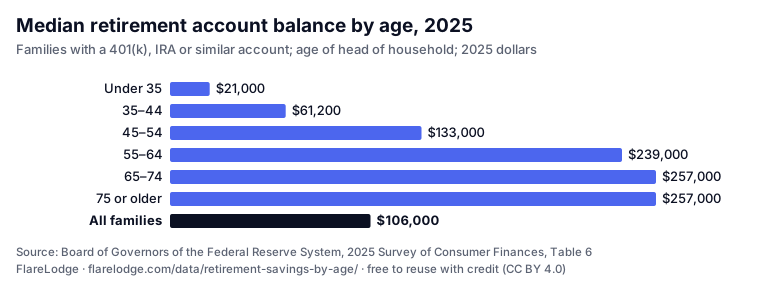
Retirement account balance by age
Age of the family’s reference person (the survey’s head of household). Balances are for families with an account, in 2025 dollars, rounded to $100. Download the CSV.
| Age | Median balance | Mean balance | Has an account, 2025 | 2022 | Change (pts) |
|---|---|---|---|---|---|
| Under 35 | $21,000 | $48,400 | 48.8% | 49.6% | -0.8 |
| 35–44 | $61,200 | $182,400 | 59.6% | 61.5% | -1.9 |
| 45–54 | $133,000 | $415,800 | 63.0% | 62.2% | +0.8 |
| 55–64 | $239,000 | $670,200 | 63.1% | 57.0% | +6.1 |
| 65–74 | $257,000 | $767,600 | 49.0% | 51.0% | -2.0 |
| 75 or older | $257,000 | $798,700 | 44.6% | 41.8% | +2.8 |
| All families | $106,000 | $451,100 | 54.9% | 54.3% | +0.6 |
2022 is shown for ownership only. The Fed’s 2022 balances are in 2022 dollars, so putting them next to 2025 balances would mix inflation into the change.
How to compare your own balance
- Compare with the median, not the mean. If you are 40 and your family has $61,200 across its 401(k)s and IRAs, you are at the middle of families aged 35–44 who have an account.
- Add every account. The survey adds all IRAs and employer accounts in the family, including old 401(k)s from past jobs. A couple counts as one family.
- This is not a target. The survey describes what families hold. Whether a balance is enough depends on income, retirement age, pensions and Social Security. The retirement savings calculator projects your balance at retirement, and the compound interest calculator shows how monthly contributions grow.
What these numbers include and leave out
- Included: individual retirement accounts, Keogh accounts, and employer accounts such as 401(k), 403(b) and thrift savings plans from current or past jobs, where the family can eventually take out the balance.
- Left out: defined benefit pensions, Social Security, home equity and ordinary savings or brokerage accounts. The same Fed table has the other financial asset types; this page does not reprint them.
- Grouping: by the age of the family’s reference person, in the survey’s ten-year bands. Single-year ages are not published.
- Means: the Fed’s mean table carries the note “estimates in this table have not been reviewed for robustness, they may be sensitive to outliers.”
Use this data
You are free to use the table and the CSV under CC BY 4.0. Credit FlareLodge with a link to this page, and name the Federal Reserve’s Survey of Consumer Finances as the source. Suggested citation:
FlareLodge, "Retirement Savings by Age" (2026-11-12), https://flarelodge.com/data/retirement-savings-by-age/. Figures from Board of Governors of the Federal Reserve System, 2025 Survey of Consumer Finances, Table 6.
Archived with a DOI: doi.org/10.5281/zenodo.24047611 (CSV on Zenodo; all versions). Suggested citation for papers and reports:
FlareLodge (2026). Retirement account ownership and balances by age of family head, United States, 2025 (Federal Reserve Survey of Consumer Finances) [Data set]. Zenodo. https://doi.org/10.5281/zenodo.24047611
Common questions
How much retirement savings does a typical 40-year-old have?
In the Federal Reserve’s 2025 survey, 59.6% of families headed by someone aged 35 to 44 had a retirement account. Among those families, the median balance was $61,200 and the mean was $182,400. The survey reports what families hold; it does not say how much anyone should have. To test your own number, the retirement savings calculator projects a balance from your age, savings and contributions.
What is the median retirement savings at 30, 50 and 60?
The survey groups ages in ten-year bands. For families with an account, the 2025 median was $21,000 under age 35, $133,000 at 45–54 and $239,000 at 55–64. Single years such as 30 or 50 are not published.
How much have retirees aged 65 and older saved?
For families with an account, the 2025 median was $257,000 at 65–74 and $257,000 at 75 or older. Only 49.0% of families aged 65–74 and 44.6% aged 75 or older had a retirement account at all. Pensions and Social Security are not counted, and many retirees have already drawn their accounts down.
What is the average retirement savings by age?
The 2025 mean balance for families with an account was $48,400 (under 35), $182,400 (35–44), $415,800 (45–54), $670,200 (55–64), $767,600 (65–74), $798,700 (75 or older). Every mean is well above the median for the same age, so the median is the better guide to a typical balance.
Why is the average retirement balance so much higher than the median?
A small number of very large accounts pull the mean up. For all families with an account the mean was $451,100, about 4.3 times the median of $106,000. The median is the middle family, so it is the better guide to a typical balance. The Fed also marks its mean table as not reviewed for robustness and sensitive to outliers.
What counts as a retirement account in these numbers?
IRAs, Keogh accounts, and employer accounts such as 401(k), 403(b) and thrift savings plans from current or past jobs, where the family can eventually withdraw the balance. Defined benefit pensions and Social Security are not included, so a family with a pension can show a small or zero balance here.
How many families have no retirement account at all?
45.1% of all families had none in 2025 (54.9% had one). The share without one was highest at 75 or older (55.4%) and under 35 (51.2%). The medians on this page leave those families out.
Did retirement balances go up since 2022?
Yes. The Fed reports that the median for families with an account rose 11 percent from 2022 to 2025 after adjusting for inflation, to $106,000. The share of families with an account rose from 54.3% to 54.9%.
Sources
- Board of Governors of the Federal Reserve System, 2025 Survey of Consumer Finances, historical tables (nominal dollars), Table 6 “Family holdings of financial assets”, retirement accounts column, by age of reference person. Opened 2026-11-07.
- Changes in U.S. Family Finances from 2022 to 2025 (October 2026): the definition of retirement accounts, and the 11 percent inflation-adjusted rise in the median from 2022.
- Survey of Consumer Finances home page.
Related: retirement savings calculator · savings goal calculator · compound interest calculator · all data pages.